Blog2026-04-30T16:28:23-05:00

Upcoming Classes & Events

American Craft Forum: Etsy Twenty Years On

Thursday, May 14 @ 12:00 pm - 1:30 pm CDT

Art A Whirl 2026

Friday, May 15 @ 5:00 pm - Sunday, May 17 @ 5:00 pm CDT

DCL: Tiny Treasure Bags

Tuesday, May 19 @ 1:00 pm - 3:00 pm CDT

Stitch Open Studio

Thursday, May 21 @ 12:00 pm - 1:00 pm CDT

Artist Blog

What is Two Fish Fibers?

This weekend Two Fish Fibers was at the Shepherd’s Harvest Festival at the Washington County Fairgrounds in Lake Elmo, MN. Shepherd’s Harvest is Minnesota’s big spring fiber festival. There are yarn and fiber vendors (like us), demonstrations of everything from weaving on a warp weighted loom to sheep shearing, food trucks, and lots of very knowledgable and enthusiastic fiber geeks.

Our booth is known as Two Fish Fibers because the three of us  – Becka, Jen and Doreen – have been partners at this show for about 16 years. It’s really hard to do a show all by yourself, so Jen (Strawberry Moon Fibers) said “we should do this together”. Doreen (Goldfish Love Fibers) and I met as a blind date for the first time setting up a mock up booth so we could submit photos to apply to the very first show. Years later, we applied to another show and the organizers insisted we couldn’t go by just our names so we had to invent a new one. Since two of our logos had a goldfish in them, we decided we could just be “two fish” when we are together. So now anytime we are out in the world as any part of our group we go by Two Fish Fibers.

Doreen and Jen are both spinners; they met at a neighborhood spinning group. All of us are teachers; Jen and I met as school residency artists for the now-retired Textile Mobile program about 20 years ago. We’ve always done demonstrations in our booth. This year we had a huge warp-weighted loom that Doreen set up with rocks-in-socks as weights while she talked to people. And we set up a “card your own batt” station with a drum carder and let people pick out their own mix of fibers to blend together.

We got a new goldfish neon sign for the booth this year and it was really fun. We got a lot of questions about “do goldfish really love fibers?” and “where are the two fish?” but it was easy for people to find us. Just look for the neon goldfish sign!

We have a big variety of things in the booth. I bring digitally printed zipper bags for notions and projects that are packed with puns. Our booth literally has the most puns per square foot of any space at the festival. I also have mini craft kits and wool eye glass cases. Jen brought hand-carded batts, handdyed and natural colored wool top from local sheep, and some beautiful handspun yarn. And Doreen had dye kits, handspun yarn, and embroidery threads.

Shepherd’s Harvest is our favorite weekend of the year.

May 11th, 2026|An Artist's Life|0 Comments

What makes you want to volunteer?

When I think about the values I have in my art practice, I try to save time to do things to support the local art community. For years I worked at an arts non-profit and every weekend during the summer I did outreach and demos in dozens of tents and parks and farmers markets. I’ve done creative work like graphic design and website maintenance for several organizations. I’ve served on boards of directors for non-profits. I’ve been a panelist and guest speaker for arts events. All things I am good at and I love doing. Because I worked at a non-profit, I know exactly how valuable volunteers are to the success of a lot of programs and I try to be one of those volunteers when I can.

One of my favorite tasks (and one of the hardest) is serving as a panelist to review grant applications. You have to apply to be a panelist and attend a training session to learn about the specific grant and criteria to look at. Then, you read and score applications from arts non-profits who are looking to help lower the cost of tickets for musical events, or buy new sound system equipment, or hire specialists to help them out. They get to tell what their need is and how it will help the organization accomplish its goals. The proposals are always fascinating to read and I learn so much about organizations I had never heard of before and art media that I don’t know anything about. I feel like grant panels are really important because I have been the recipient of several grants; someone sat on that panel and evaluated my proposal and so I feel like I am paying the community back.

Sometimes it’s hard to be a volunteer.

I’ve had some volunteer jobs that ended up being not a lot of fun. I had long-term volunteer job that broke down recently into a not so great situation. We were working on a couple of big projects and things just melted down. I think there was some miscommunication and some timeline stress behind the scenes. I emailed some other non-profit friends for advice. How should I handle this? What do I do to not make the situation more stressful? Should I just step away?

One comment really stood out for me and I keep thinking about it: I never volunteer to do something I get paid for.

My friend basically said that “volunteering your time is not the same thing as giving away your expertise”, especially when it comes to creative/art work. There’s an idea that creative volunteer work is supposed to be “fun” and flexible. You can do revisions, slip timelines, or change things on the fly because it’s free volunteer work and something you do for fun or because you believe in the cause. However, the exact same tasks become more “official” and valuable the minute someone gets paid for it.

We laughed when I said “no one has ever given me a hard time about how I cleaned up trash after a fundraising party”.

That statement is abolutely not true for other more skilled volunteer jobs like graphic design. Ironically, the creative work that I’m good at is much harder and less rewarding to volunteer for than things like folding programs, working the registration table, or cleaning up the trash.

So I’ve been thinking about that statement a lot.

I’m curious: Do you have boundaries or rules that you set around volunteering? What makes you want to volunteer? Or NOT volunteer for something?

May 5th, 2026|An Artist's Life|2 Comments

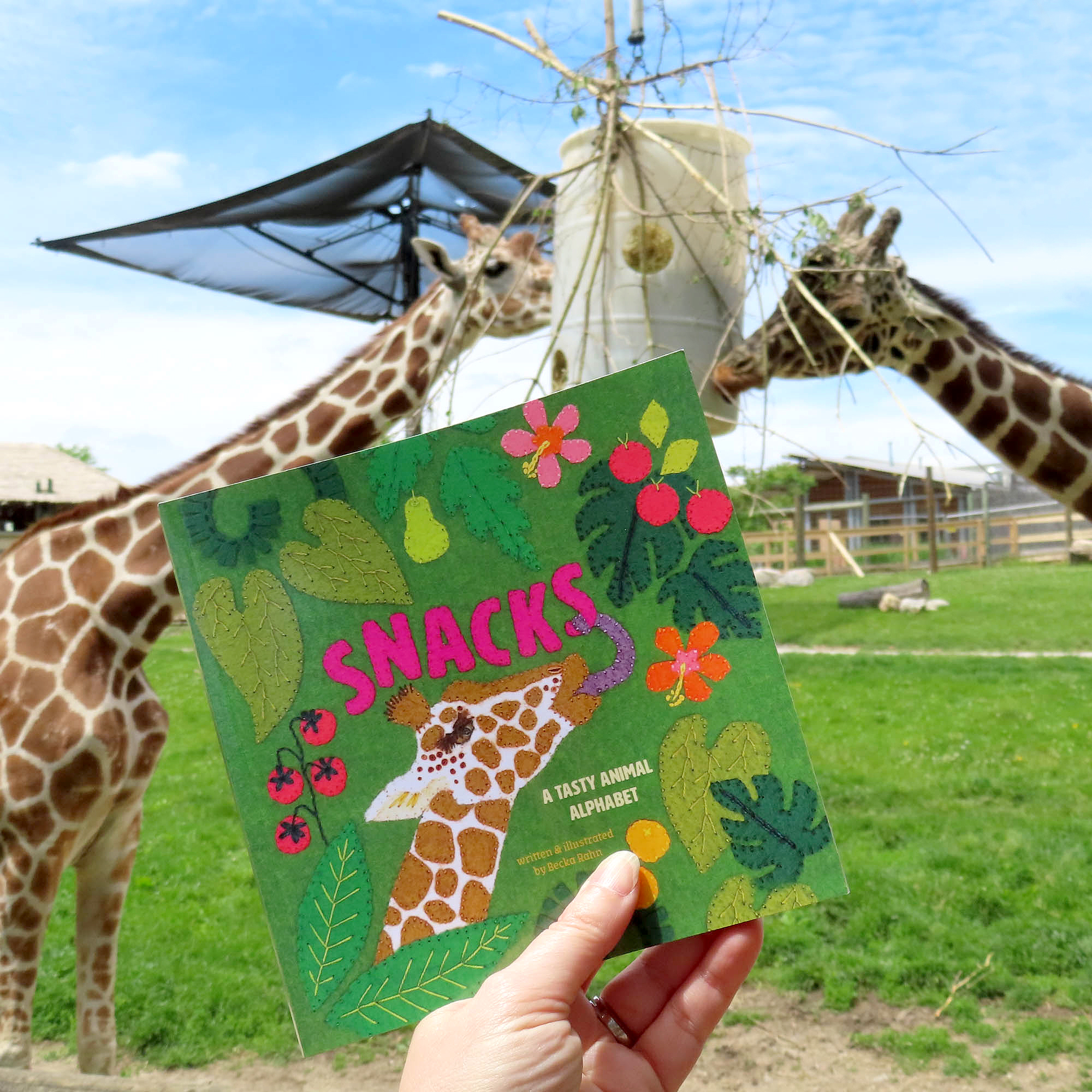
Snacks: How I wrote, illustrated, and published my own alphabet book

So sometimes the path to writing a book absolutely doesn’t start with the idea “I’m going to write a book.” In fact, I’ve now written and illustrated four books and none of them started out as a book at the beginning of the project.

Snacks is the book I have been working on for the last year. Snacks started with slippers. Sometime in 2024 I ordered a beautiful felt slippers kits from a place called Joe’s Toes. I made them up and decided that they were a little plain, so I drew some felt humpback whales and appliqued them on the toes. They turned out really cute. They were such fun to stitch that I looked around and spotted felt eye glass cases made by the same awesome people. So I ordered some and made a few glasses cases for family and friends. My mom got a portrait of her dog, I made a green jay with edelwiess to celebrate my mother-in-law’s trip to Switzerland, my friend Goldfish Love Fibers got a goldfish.

I was having so much fun, I ordered some more felt. And I made a batch to sell at a local craft fair. I sold out in the first hours of the show. I made a few rules for myself: they had to be unusual animals; no cats and dogs. I wanted them to be the odd things that people love and not get trapped into making custom portraits of people’s pets. So I made tapirs, sloths, axolotyl, platypus, seahorses and yaks.

One afternoon, I decided to photograph them. I thought “I don’t know what I am going to do with these photos”, but I want to document them because I am doing so many different creatures. So that became part of the process: stitch the animal, photograph it, fold and stitch the case.

Then one day I made a list and realized that I had like 18 of the 26 letters of the alphabet represented. With just a few more odd letters like J and U, I would have an entire alphabet.

I’ve always loved alphabet books. I like that such a simple theme can become a story. So I decided to make the rest of the letters in the alphabet.

I’ve sold nearly all of the glasses cases that are the exact animals in the book. I decided that this was my most fun art recycling project yet! Make practical things for people to use and then use the photos to make something entirely new. I also love any reason to recycle my own art. For a long time, I have used parts of fabric designs as a texture in another. The previous books I mentioned all started as a completely different project and then I realized I had all the art, why not make a book?

So I stitched U (uromastyx, a kind of lizard) and J (jaguar) and all kinds of other animals in between.

How did it turn into a book?

Once I had the alphabet idea, I knew I would also need to stitch the alphabet. That was my project last year at the annual open studio event I do. I stitched alphabet letters while I chatted with people. These were stitched on felt coaster samples. I like working on thick felt as a backing and so I tracked down some sampler packs on Etsy.

Before I was settled on book, I thought about making a postcard set with each animal and its letter as a postcard. But I put a survey in my newsletter and “make a book” got way more votes.

So, then I thought this book really needs a story. Just having the animal and a letter is kind of boring. It took me a few months to come up with the idea of “snacks”.

I was talking to my mom and remembering a trip to a zoo we were on together. The zookeeper told us about this little river otter who always pounced on the food bowl very first thing so she could grab the shrimp. She would eat the other things, but the shrimp were her favorites and she would shove everyone else out of the way to get to them. The story made us laugh and we still remember it years later. So I thought, I wonder if there are other stories like this. Animals who have favorite foods or treats that aren’t the foods that are listed in their official stats.

So many emails.

I started sending emails. I researched and emailed dozens of zoos to ask about specific animals and their quirky snacks. I made sure that I was asking an easy question to reply to: an individual animal like a sea turtle and just one specific thing that their turtle liked to eat. I tried to explain that I wanted to know especially about their animals and not the wikipedia “what does this animal eat” answer. I told them I was an artist and I was planning to hand embroider all of the illustrations. I had a spreadsheet to keep track of who I emailed, what they said and other notes and comments.

Fortunately some of those zoos responded right away and their staff thought that the project sounded whimsical and fun, just like I did. I got some delightful emails back with funny stories and details. You could tell that these zookeepers and education staff really loved their animals as individuals with personalities all their own. This was the most fun research I had ever done for an art piece! I would excitedly text my family “Zebras like tomatoes!” I expanded my emails to also include rescues and other animal rehab or welfare organizations in a quest to get a real answer for every one of my alphabet letters. One of my favorites was from a oceanlife rehab organization who had a female red-footed booby in residence. They said her favorite thing was squid and she would grab it from the staff person and shake it (like a dog does) and spray squid slime all over the face of her keeper. They affectionately dubbed it “getting a squid facial”. A large-and-friendly national aquarium said that their sea turtles loved vegetables but only the green ones. If you gave them red and green peppers, they would ignore the red ones. Two local zoos to me – Como Park Zoo and Bramble Park Zoo – were especially friendly and chatted with me back and forth about the idea and their animals. It was conversations like that which kept me inspired by this project!

Other emails weren’t as much fun. Some places never responded at all. A small number of them sent me a long legal referral email to the marketing department about partnerships and licensing. A few sent generic “we are too busy to answer questions” responses. Those were bummers. The funny thing was that you could really tell the places that prioritized learning and sharing their animals and the ones that were “corporate”. Sadly for me, several places had policies about not quoting or recognizing their zoo by name for answering questions like this. I had big plans to put a whole list in the back of the book with thanks to everyone who helped, but I had to leave that out at their requests.

Finally I stitched the snacks; thanks to my spreadsheet of notes! I decided to put them on small pentagons and the letters on rounded squares so there were some shape hints in the book too (ie you know to look at the pentagon for the snack).

I didn’t realize it at the time, but I wrote a non-fiction book! I drew my animals using a lot of reference photos from zoos, which I decided was a more reliable source than Google, which is so full of AI slop that I don’t trust it to be really a true representation. Every one of those snacks I stitched was because I talked to someone knowledgeable about that animal.

Making the book pages.

I put together each page in Photoshop. Looking back, I don’t think I would ever have sat down and embroidered all 64 pages worth of illustrations one by one. But since I did them as a whole series of other smaller projects, they were really easy to assemble. I have used the photos of the letters for several other projects already and I am planning to make an alphabet animal fabric panel/design too. I love how versatile they are.

Once I had settled on snacks as the theme, I wrote out the text for the book identifying the animal and its snack. My family helped me brainstorm 26 different words for eating something so each letter had its own verb to go along with it.

Armadillos slurp creamy peanut butter.

Boobies nibble squishy squid.

Every snack also has an adjective, often with alliteration or just because I thought it was fun to read out loud. I also realized I needed a little intro and conclusion for the story so I stitched a few more illustrations specifically for those pages. I decided that leaf-cutter ants would be a great illustration for the page where I talk about how I made the illustrations by cutting up and sewing together felt.

All together there are 95 different stitched pieces plus the cover!

For those that enjoy the technical details, I decided to print the book with Ingram Spark, who are a huge indie book publisher. I approached several print companies about trying to get it done locally and the cost was just too high. Because I am self-publishing, I have to pay all the costs myself up front. One place was really great and gave me a quote of about $14 per book, but in order for me to be able to make anything to pay myself, I would have to mark it up to a place that doesn’t make sense for a paperback kids alphabet book. Ingram was able to print it for about half that price. I purchased my first ISBN number so this one credits me as the publisher. (I printed previous books differently and they handled ISBNs in a different way). I should be able to make it available for bookstores and libraries to be able to order it but I haven’t set that up yet.

If you are thinking about printing with them, I have been pretty happy with what I have gotten but its *hard* to make sure you follow all the specifications and directions correctly and they have terrible customer service. It’s frustrating and they aren’t very friendly. I had two mis-print problems with the proof copy of my book. One was my error, which I fixed without their help and the other was 100% their fault and they have not yet responded to my support ticket. I’ve got a second proof that is great and I ordered a case of books and I have all of my fingers crossed that they are awesome when they arrive. (This is why I am not taking pre-orders. I don’t quite trust it until I see it.) Hopefully I will have them in the next couple of weeks.

Edited to add: The BOOKS ARE HERE.

April 15th, 2026|Everything Else|7 Comments

Behind the Scenes Creating a Class: From Idea to Finished Project

Someone asked me recently about how I come up with ideas for classes and I thought it would be fun to talk through how I design a class from the first idea to a finished workshop. This owl project is a great example and it actually ended up turning into two different classes for me, which is great!

Where I got the idea

I teach often for the local county library system and we always ask students for an evaluation at the end of class. A couple of the comments mentioned that students wanted more classes with paper art and they loved a recent one we had done with recycled materials. The libraries also had a theme or mascot for their spring classes which was owls. So I decided to put those together into a class: making recycled paper owl ornaments.

I start with materials

You might be surprised to know that one of the considerations I think about right away is materials. I often have a materials budget per student that I need to stick to. This includes both acquiring the materials themselves, and also any time that it takes me to prepare them. So if I need to dye something or cut pieces or make mini skeins of yarn, I put that together with my materials costs. A recycled paper class isn’t a high cost for getting materials, but it does take time to source enough of everything to make up 43 kits. Sometimes that is more of a challenge than you might think. Even if I am teaching an in-person class, I think about materials and what is practical for students to acquire before class or what I need to supply to make it easy to come and jump right in to the project. For beginner classes, I don’t like to make anyone go out and purchase a bunch of bookbinding tools, for instance, before they have even taken the class to see if this is something they like doing. I usually sketch out the materials costs on a scrap of paper with some quick Google searches to make sure I can get everything I need within budget.

For the classes I teach with the libraries, we mail out materials kits because the classes themselves are held on Zoom, so there is also a size constraint so everything fits in the envelope. I also need to think about things that are practical to mail. Paint, liquid glue, and magnets, for example, aren’t the ideal things to put in the mail. For these Zoom classes, I try to limit what the students have to supply themselves to scissors, pencil and occassionally a ruler. Everything else is in the kit.

Figuring out learning goals

I like to also make sure that we aren’t just doing a cut-and-paste kind of project, but there is some kind of new skill that students are learning. Those skills could be something like a new embroidery stitch or a way to tear down paper.

So for these owls I decided that we would:

  • make an ornament with paper-covered chipboard, teaching bookbinding skills of making covered boards
  • create a mixed media illustration with mixed scrap papers and stickers
  • design our own patterned paper to help make colors blend/coordinate

Make a sample

Next I make a sample project. I am not really an artist who sketches everything ahead of time. I usually jump in and just start trying things. I have a couple of drawers of scrap paper in my studio, so I grabbed some scrap and started to make a project.

Fun fact: I looked at the date on this photo and I made this sample in June 2025. I didn’t teach this class until January 2026. I always take photos of samples and intermediate steps as I make them because there is often a huge lag between when I propose a project and when I actually teach it so I forget what I did.

As I made this sample I thought about how I would teach it to students. I decided to make pattern pieces for the head and body and have the students create the pieces for all of the other shapes. This would give them a starting point to get everything the right size to fit on the background and would help give some confidence about making your owl look like an owl. I made pencil sketches of the pieces I made and then re-drew them in Illustrator so I had pattern pieces I could print for them to cut out.

I decided to use little circle stickers for the eyes to give this a little more mixed media vibe and because cutting tiny circles is a pain-in-the-%$#@ and I don’t want to cause anyone to be frustrated. Ultimately I also made the entire piece slightly bigger than the one shown in the photo here because I decided that the pieces were too small to cut easily, especially for more beginner level students. Since I had drawn those pattern pieces as vector illustrations, this was easy to do.

Take photos.

Usually this is the point in a project where I write a class description and take some photos of my sample. When I am teaching classes, there is usually a “proposal” phase where I send something off to whoever I am partnering with for the class and they approve the idea before we move forward. Writing class descriptions is hard. I’ve learned over many years of doing it to be as concise and factual as possible. I’ve learned this the hard way as you might guess. Sometimes the people editing the description down the pipeline don’t understand anything about what I’m teaching and the class description ends up being something completely different than what I intended to teach.

Now we wait.

I try not to do any more prep than this until I have a signed contract. Rarely do teachers get paid anything for prep time. Unfortunately I have had venues ghost me or cancel projects at this point, so I am really careful about doing anything like making handouts or actually sourcing materials until I know it’s pretty sure that it’s going to go.

3 weeks out.

About three weeks before the class I start to look for materials. For larger classes, like the ones I do with the libraries, I might even start a little earlier to get materials on the way. I try to order things from other small businesses as much as possible. I rarely source materials locally, even though I would like to because it’s challenging to find enough of a thing to make up 43 class kits from a local shop. They just aren’t going to carry 43 skeins of the same color of yellow DMC floss. Some tools like popsicle sticks or glue sticks, that I use over and over in classes I buy in bulk if I can to keep the costs down. While some classes are pretty predictable (my library classes almost always fill up) others are a big guessing game. Many many people wait until the last minute to register for classes, so at 3 weeks out, I really have no idea how many people I will have in a class.

2 weeks out.

I make up materials kits. You’ve seen me mention the number 43 a bunch of times. For this class, I had 40 spots available, broken up into 2 class groups. I also make a kit for me that is identical to the student kits so we are all working with the same thing (42). I make one more so that I can make a class sample that is the exact materials that are in their kits (43). My prototype sample is almost always made with whatever I have scraps of in the studio so it’s a great alternate example, but it doesn’t always match exactly what they will be working with. I also make handouts and pattern pieces at this same time.

For the library classes, I drop off kits so the library staff can distribute them.

Today I am teaching a different class in person. I made up those kits just a few days before class because I wanted to not make too many and have leftovers. I have a better idea of how many students will be in a class a few days before it happens. For those classes I always make the number in the class plus three extra. One for me to work along with them and two more for people who show up and think they were registered even though they weren’t (it happens more than you might think). I had a woman spill her entire coffee all over her materials and the table once. I had an extra kit so she could start over.

The day before

I usually make up the class sample the day before class happens. I do this last minute because it means the class is super fresh in my mind. As I make the sample, I keep notes on a scrap of paper so I don’t forget key steps or do things out of order. This is kind of the point when I write the lesson plan. I often translate those sketched notes into a list of numbered steps with keywords for me to remember what to do next. If I’m teaching on Zoom that note usually sits on my laptop keyboard where I can see it but it’s just off camera. Sometimes with complex projects I put times on it so I make sure we stay on pace to finish on time, ie at one hour in to class we should be to this point.

I taught it, but then I taught it again

So after I taught this class, another group reached out to me and said we saw this class on your social media and we think this would be a great fit for this other event we are doing. Cool! So I talked to them a little bit and they wanted basically this same project but as a 25 minute class formatted as pre-recorded video. That’s a big change from the 2 hour class that I had planned earlier. I decided that I could do it by changing the skills focus of the class a little bit but keeping the same project.

The new goals were something like this:

  • demonstrate covering boards with decorative paper (not a step-by-step)
  • discuss how to curate papers/colors to make a cohesive design
  • demonstrate creating a mixed media illustration with bullet points vs working together

In order to cut the class down from 2 hours to 25 minutes, I changed all of the detailed step-by-step instructions into demonstrations with bullet points, more like a tutorial. I added a section about curating your recycled materials to make something that looked more intentional than crafty. For the original class, I curated the materials in their kits so we didn’t need to talk about that. But for this one they would be sourcing their own materials, so that felt like an important thing to talk about. The focus shifted more to the design of the project and away from the hands-on-skill building.

I already have a whole video setup and workflow to record a class so I sat down one afternoon and recorded it. I had my samples from teaching the class previously, so I had a lot of things to show for inspiration. My first draft of the video was way too long, so I had to cut a lot and speed up some of the sections where I was doing demos. I’m not used to teaching in such a short form, so this was a little more work, but I think I would get better if I did more like this.

Want to make an owl? This class is happening as part of a free Eco-Creative Summit in a couple of weeks, so if you are excited about this project you can sign up!

April 9th, 2026|An Artist's Life, Classes & Teaching|1 Comment

Hi, I’m Becka.

I’m all about sharing what I know and giving a real look at the creative life—both the art and the business side of being an artist.

I teach online and in-person classes covering embroidery, handcrafts, fabric design, creative technology, and practical artist business skills to help makers grow with confidence. I’m also the co-author of The Spoonflower Handbook and a Skillshare instructor.

When I’m not teaching, you’ll find me creating books, exploring paper art, and diving deep into all things fiber art (with a healthy dose of creative geekery).

Shop my art

Get my new book

Featured Video Class

Frog & Dragonfly Basket

Latest Art

When Vexed

Recent Comments

Go to Top